




(NEW YORK) -- Thousands of canceled flights in Europe over a spike in jet fuel prices. An energy emergency declaration in the Philippines. A two-week school holiday in Pakistan to conserve fuel used by commuters.
The U.S.-Israeli war with Iran triggered dramatic steps in a slew of countries bent on weathering one of the worst oil shocks in history, stoking concern by some about a possible global recession.
Economists disagree about whether the standoff in the Strait of Hormuz will ultimately drive the world's economy into a downturn, in part because the duration of the waterway's effective closure remains murky. The outcome holds implications for the livelihoods of billions of people and the performance of companies big and small across the globe.
Some analysts said they fear the oil shortage will soon become so dire that crude prices could rise sharply driving up costs for an array of goods and hammering shoppers. The fallout could squeeze businesses and shrink growth, they said.
Others proved more optimistic, pointing to a smaller rise in oil prices than some feared and a recent track record of economic resilience in the face of trade wars and other turmoil. A worldwide downturn, they said, would require a much more prolonged closure of the strait.
"The longer this drags on, the costlier it becomes," Ryan Sweet, chief global economist at Oxford Economics, told ABC News.
Still, Sweet added: "Whether or not this will cause a global recession, it's premature to say."
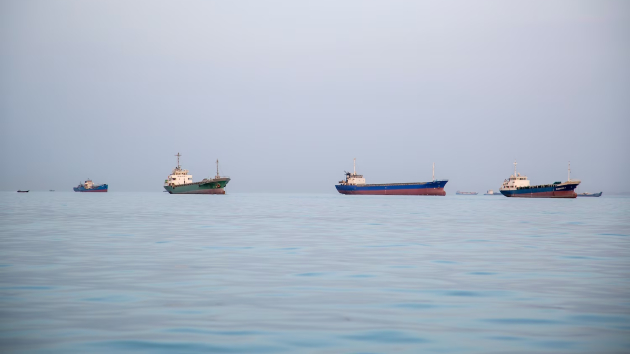
The conflict, which began on Feb. 28, prompted Iran's effective closure of the Strait of Hormuz, a critical waterway that facilitates the transport of about one-fifth of the global supply of oil and natural gas.
The vast majority of oil that passes through the strait is bound for Asian markets. But since oil prices are set on a global market, prices have climbed for just about everyone as buyers chase fewer barrels of crude.
On Tuesday, Trump extended a ceasefire with Iran, averting a resumption of wide hostilities, although the move left the strait under Iran's effective control. The U.S., meanwhile, has mounted a blockade of Iranian ports in the strait, squeezing a key source of government funds derived from oil exports, while exacerbating the global petroleum shortage.
The Brent futures price, the benchmark index for global oil trading, registered at about $106 a barrel on Friday. That price stood about 50% higher than its pre-war level.
Higher oil and gasoline prices risk a pinch at the pump, as well as additional costs for just about every product delivered across the globe on trucks or ships that run on diesel fuel.
"Oil feeds into inflation, which reduces raw purchasing power -- how much bang for their buck people have," Sweet said. "That slows the economy."
Still, oil prices remain below the highs reached after some previous economic shocks. In 2022, the price of Brent crude surged above $139 per barrel in March, just weeks after the Russian invasion of Ukraine. During the 2008 financial crisis, U.S. gasoline prices shot up as high as $147 a barrel.
Some economic forecasts issued in recent weeks projected that global economic growth could escape the crisis relatively unscathed, as long as the war reaches a resolution in short order and oil prices avoid a steeper climb.
The Organisation for Economic Co-operation and Development (OECD) last month predicted that global gross domestic product (GDP) growth would "remain broadly stable" at 2.9% in 2026. That forecast matched projections issued by the OECD in December, before the war.
The OECD touted strong tech investment and lower-than-expected tariffs, citing "carry-over from robust outcomes in 2025."
Earlier this month, the International Monetary Fund (IMF) projected that GDP growth would register at a solid pace of 3.1% in 2026, noting that the global economy had withstood "higher trade barriers and elevated uncertainty last year."
The forecasts from the OECD and IMF worked under the assumption of a resolution to the conflict by the middle of this year, acknowledging the impact could worsen if it stretches on for longer.
Some economists, by contrast, consider the economic threat a more urgent risk.
Paul Krugman, an economics professor at the City University of New York Graduate Center and a former columnist at the New York Times, criticized the IMF projection on Substack on Monday, faulting the group for "seriously underestimating how badly the global economy could be hit."
"In my view, a full-on global recession is more likely than not if the Strait remains closed for, say, another three months, which seems all too possible," he said.
Rosier forecasts fail to adequately factor in the risk of a significant rise in oil prices over the near term, Krugman said, warning of widespread "demand destruction" as oil becomes increasingly scarce. Under such a scenario, a surge in oil prices would make it unaffordable for many buyers, forcing them to find alternatives or forgo energy use altogether.
Technical definitions vary about what constitutes a global recession, but the gist is a period of sluggish or negative economic growth. For the World Bank, a global recession amounts to a contraction in global per capita GDP; while the IMF considers GDP growth below 2% sufficient to warrant the label of a recession.
A six-month impasse in the strait could push global oil prices as high as $190 in August, Oxford Economics said in a blog post last month. That price shock would send global inflation to 7.7%, near its peak in 2022, the independent economic advisory firm said.
"But unlike 2022, when the global economy kept growing through the price shock, the severity of this disruption tips the world into outright contraction," Oxford Economics added.
In addition to its optimistic baseline projection, the IMF issued a downbeat prediction in the event of a more severe disruption of oil markets that stretches into next year. Under those circumstances, the global economy "would come close to experiencing a recession," the IMF said, noting that it defines a global recession as annual GDP growth below 2%.
Growth below 2% has happened four times since 1980, the group said.
Across the board, economists acknowledged a high degree of uncertainty as the Iran war unfolds. Plus, some said, the negative effects will be unevenly distributed, hitting harder in low-income countries as well as those who depend on oil that passes through the strait.
While the full extent of economic wreckage remains unknown, the prospect of an extended global impact is all but certain, Sweet said.
"This will take a long time to get back up to resembling anything close to normal," he added.
Copyright © 2026, ABC Audio. All rights reserved.









.jpg)

.jpg)